
Daggett Projected Versus Actual Release
A projected release date is a current estimate or authorized future date, not a guarantee that the person will walk out on that date. In Utah's public UDC detail view, the exact combined label is “Release Date/Type.” The system does not call it a separate “projected release date” or “tentative release date.” When that value points forward, it should be described as the date and type UDC currently displays, subject to later Board action and agency updates.
Actual release is the physical custody event. It may occur after final checks, transportation, and confirmation that no other hold applies. A transfer is not actual release to the community. A person can leave a county jail for UDC, federal, immigration, or another county custody. A state prisoner can move to a community correctional center while remaining within a corrections framework. The exit record and receiving-agency entry distinguish those events.
Daggett County's local setting makes that check essential. The Daggett County Jail closed and has no present release desk. The agency that actually booked or holds a recent Daggett arrestee has the jail timing record. State prisoners follow UDC and Board records. Federal prisoners follow federal systems.
Find a Daggett Release Date
Start with custody type. The Daggett County Sheriff can identify the receiving jail for a recent arrest. A local pretrial detainee's release depends on bond, court orders, case resolution, and holds, so there may be no fixed date to calculate. For a local sentence, request the commitment, applicable credit, release entry, and any transfer destination from the real custodian.
A sentenced Utah state prisoner is different. Search the UDC Offender Search by UDC number or by name. Name searches need at least one letter in both first and last name. Open the correct detail record and copy “Release Date/Type” exactly. Then compare the Utah Board decision and effective date. UDC's current public search covers only people incarcerated by or on probation or parole with the department, so a fully discharged person may no longer appear.
- Identify county-jail, UDC state-prison, federal, or immigration custody before interpreting any date.
- For county custody, ask the receiving jail or court whether a sentence exists and which holds apply.
- For UDC custody, search by offender number when possible and match the person's identifiers.
- Record the exact UDC Release Date/Type value, location, and facility placement.
- Search the Board decision and read its effective date, conditions, and any later rescission or review.
- On release day, compare the official field, Board order, VINE event, and direct agency confirmation.
For an older Daggett record that is not online, the county GRAMA form can seek a narrow retained custody or transfer record. Ask for named fields and a date range. The Daggett County release-record search explains the complete court, receiving-jail, UDC, and federal path.
The official UDC search interface provides the source view for the state release field.
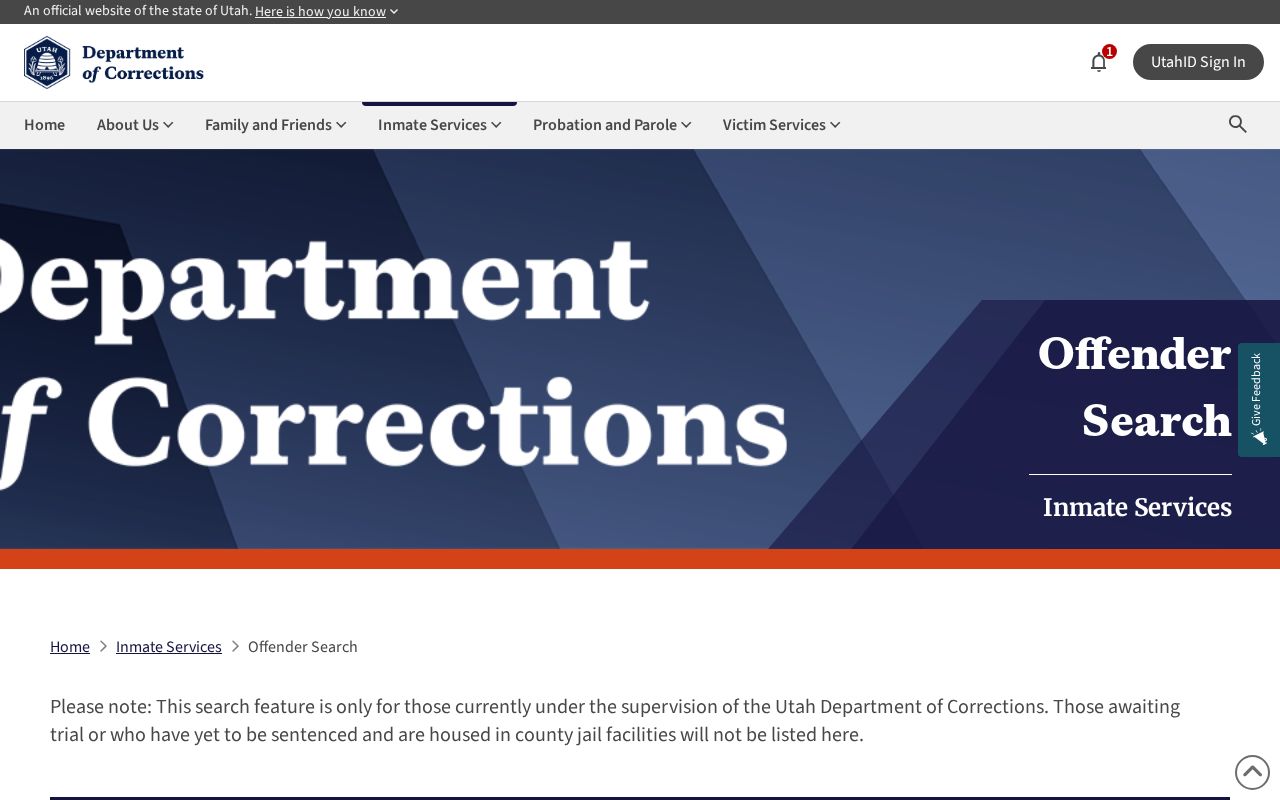
The captured UDC view shows why the combined Release Date/Type label must be copied without turning it into an unconditional promise.
Utah Sentences Shape Daggett Release
Utah state-prison sentences are generally indeterminate. Under Utah Code § 77-18-111, the court imposes a sentence bounded by law rather than one definite exit date in the usual state-prison case. The Utah Board of Pardons and Parole combines concurrent and consecutive sentences, reviews its guideline and case material, schedules hearings, and acts within its release authority. A guideline is not a guaranteed date.
The original hearing date is also not a release date. A Board search may show a scheduled hearing, hearing type, final expiration date, or later decision. Following an original hearing, the Board may set parole, require added programming, or schedule another review. A rescission hearing can remove a date before release. Official material says decisions may post weeks after the hearing, which creates another reason to distinguish the calendar from the controlling order.
There is no general Utah rule that every state prisoner must serve 85 percent. That shorthand cannot be imported into a Daggett County calculation. A sound state projection begins with the judgment, sentence aggregation, and presentence credit, then adds Board orders, earned-time action, release contingencies, and any later rescission or violation decision.
- Indeterminate sentence
- A prison term set within statutory bounds, with the Board exercising release authority.
- Concurrent sentences
- Sentences that run at the same time, subject to the controlling judgment and Board calculation.
- Consecutive sentences
- Sentences that run one after another and may extend the release framework.
- Rescission
- Board action that withdraws a granted date before physical release.
Note: A sentence maximum, guideline, hearing date, Board effective date, and actual exit can be five different points in one record.
Daggett Release Credits Differ
Utah has two distinct credit mechanisms relevant to Daggett cases. State earned time comes through the Board program in § 77-27-5.4. It applies to successful completion of specified recidivism-reduction programs recommended in the person's case action plan and approved by the Board or UDC. The statute provides at least four months for each of up to two eligible programs, with Board discretion for additional credit.
That state credit is not automatic day-for-day good time. Statutory exclusions can apply, including too little time before an already ordered release, life without parole, a Board order to expiration, no current release date, an unmet release contingency, or a Board termination date. Credit can be forfeited if a rescission hearing becomes necessary. Program completion must be reported, and the Board controls its effect on the date.
County-jail good behavior is separate. Under § 76-3-403, a custodial authority may, in its discretion and for good behavior, allow up to ten days for each thirty days served in specified misdemeanor incarceration, or up to two days per ten days for a term under thirty days. The rule can also reach jail time imposed as part of felony probation when the district judge did not order otherwise.
For a current Daggett local sentence, the actual receiving jail applies any eligible jail credit. The closed county facility cannot calculate it. The commitment, judicial restrictions, presentence credit, custodian's determination, other cases, and holds all matter. A pretrial detainee has no sentence-based credit date.
Two Daggett Release Credit Systems
The practical Daggett County question is not “How much good time does Utah give?” It is “Which lawful credit system applies to this custody track?” Board-controlled state earned time follows an indeterminate prison sentence and approved programming. Discretionary jail good-behavior credit follows a qualifying local commitment and the actual jail's determination. They are not interchangeable, and neither supports a universal percentage formula.
| Credit route | Decision maker | Key limits |
|---|---|---|
| State earned time | Utah Board with UDC program reporting | Approved case-plan programs, statutory exclusions, Board control |
| County-jail good behavior | Actual custodial authority | Qualifying terms, judicial limits, discretionary award |
| Presentence credit | Judgment and official sentence calculation | Must be verified from the case and custody history |
| No sentence yet | Court and custodian control release conditions | No sentence-based projected release date exists |
A receiving jail should be asked for the calculation it actually used, not a guess based on the old Daggett jail or another county's practice. For state custody, use the Board order and UDC record. Any calculation made without the judgment and full custody history can omit a controlling fact.
Why Daggett Release Dates Change
A displayed state date can move after new Board action, an earned-time grant or forfeiture, a program or placement issue, sentence aggregation, a violation warrant, or a data correction. A local jail date can change through a court order, credit determination, or hold from another agency. These changes do not all mean misconduct. Some are administrative or follow a new lawful order.
| Factor | Possible effect | Record to check |
|---|---|---|
| Board order or rescission | Sets, changes, or removes a state parole date | Published Board decision and order |
| Earned-time action | May advance a state date or be forfeited | Board order and UDC calculation |
| Program or placement contingency | Can delay a planned state release | Board order and UDC confirmation |
| New sentence or aggregation | Changes the controlling term | Court judgment and Board record |
| Local good-behavior credit | May reduce a qualifying jail term | Receiving-jail calculation |
| Detainer or transfer hold | Prevents community release or sends the person to another agency | Exit log and receiving-agency confirmation |
| Data correction | Changes a public display without a new sentence | Agency confirmation with search date saved |
Read the event type as carefully as the date. Release to parole, discharge, transfer, expiration, and movement to another site have different effects. When a state prisoner returns on a parole violation, a later Board hearing may set another date or continue review. A violation allegation is not itself a new conviction.
Confirm Daggett Release Day
UDC says prison releases and paroles are processed every Tuesday, with most people processed at the Utah State Correctional Facility. People housed at the Central Utah Correctional Facility ordinarily report through that USCF release-building process. This operational cadence helps families plan a final check, but it does not promise that every displayed Tuesday date will result in community release.
A person may instead move to a community correctional center, face a later order, or have a hold. Check the UDC Release Date/Type field and Board order again. Then use a Utah VINE event as a timely signal and confirm with UDC. The Daggett County VINELink inmate search explains the PIN and notification steps.
The official UDC release-day instructions document the statewide Tuesday process shown below.
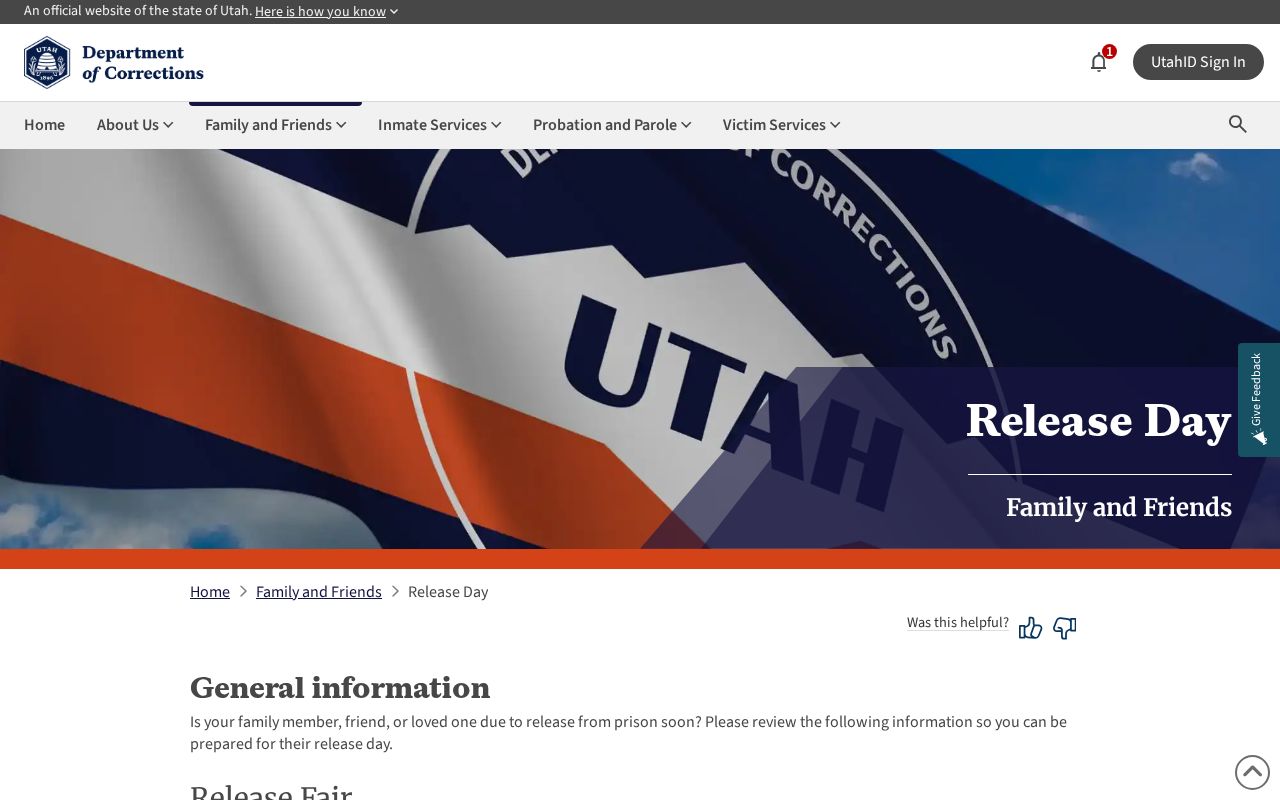
The statewide release-day source supplies the final logistics check for a Daggett state prisoner, while the Board order and UDC record still control the individual case.
For a county detainee, call the receiving jail instead. For a federal prisoner, use the BOP locator and federal records. Keep each search date and exact label. The final proof is the custodian's physical-exit entry, including whether the person entered the community or transferred to another authority.
When no live result survives, request the narrow record that answers the timing question. For a local Daggett case, that may be the commitment, credit calculation, release log entry, and destination field from the receiving jail. For a state sentence, it may be the Board order and UDC discharge record. A court docket can confirm the judgment or later order, but it does not normally certify the hour of physical release. Matching those records preserves the difference between authority to release and the completed exit.