
Daggett County's 24-Hour Release Gap
There is no official Daggett County 24-hour released-inmate list. The county jail page says the former Daggett County Jail closed in February 2017 and does not appear likely to reopen. It has no current population and produces no present-day releases. The Sheriff's official pages provide contact, records, Utah corrections, and VINE routes, but they do not expose a live roster, a release tab, or a filter for the last day.
This absence is operational, not a web outage. A search result from a stale directory should not be treated as a Daggett County release record. Likewise, a list of local arrests does not become a release list unless the actual holding agency records each exit. A person arrested in Daggett County may be taken to another agency, and that destination must be confirmed case by case.
The official closed-jail notice shows why there is no same-day feed. The Daggett County jail source is captured below for a clear starting point.
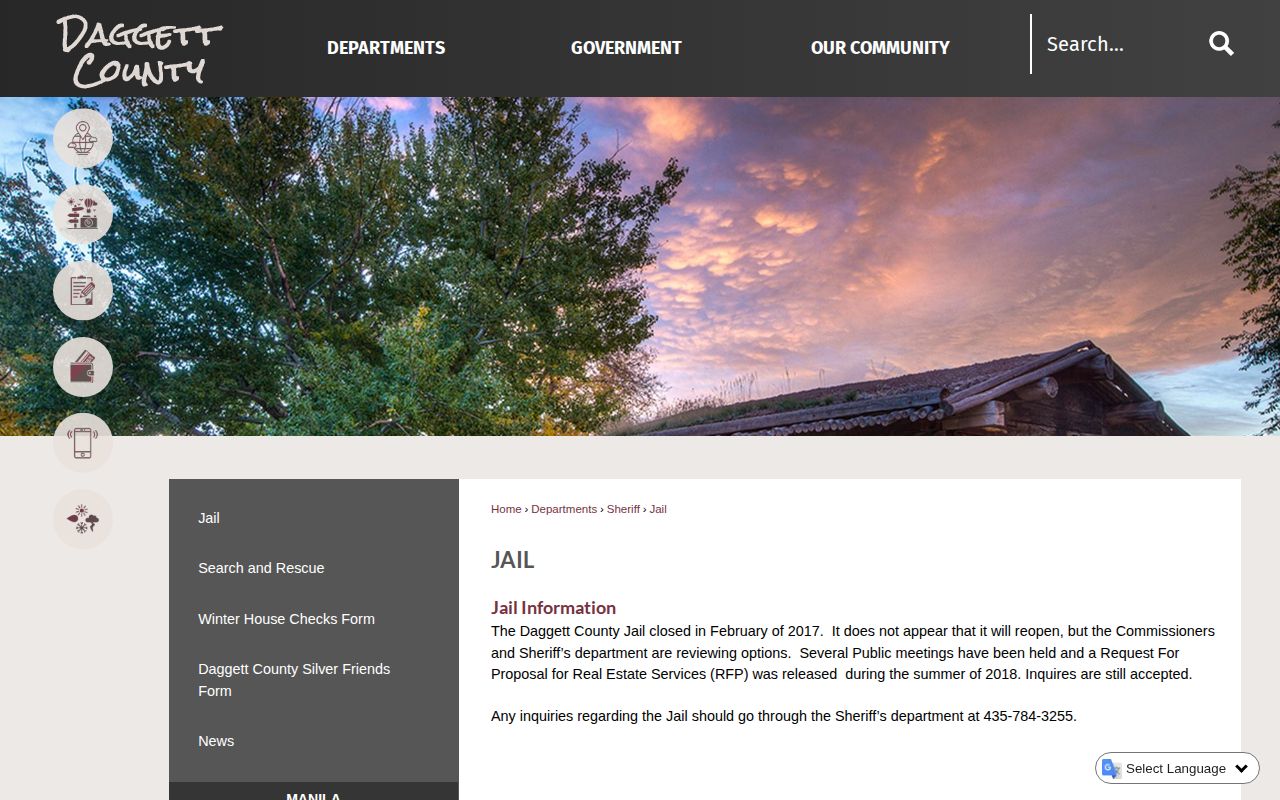
The notice routes questions to the Sheriff instead of presenting an inmate list, which matches the correct current release workflow.
Check Daggett County Same-Day Releases
A same-day check is a custodian-identification task. Start with the time and place of arrest, the person's full name, and any case or incident number. The Daggett County Sheriff's Office posts 435-784-3255 for its office and 435-789-4222 for Consolidated Dispatch. The posted office hours are Monday through Friday, 8 a.m. to 5 p.m. Ask which facility accepted the person rather than asking only whether the person is “in Daggett jail.”
- Mark the search window. Write down the exact current time and calculate the prior 24 hours so the request has clear bounds.
- Identify the receiving agency. Call the Daggett Sheriff or Consolidated Dispatch with the person's name, event location, and approximate arrest time.
- Contact the actual holder. Ask its records or jail staff for the exit date and time, release type, releasing authority, and destination.
- Distinguish exit from transfer. Confirm whether the person entered the community or moved to another county, UDC, federal, or ICE custody.
- Corroborate the event. Compare the exit entry with a court order, Board record, or VINE event, then resolve any conflict with the custodian.
Uintah County Jail may be a useful first contact after the Sheriff confirms it as the receiver. Its official public number is 435-781-1300. It should not be assumed to hold every person arrested in Daggett County. For a named-person search that extends beyond one day, the Daggett County released-inmate search lays out the wider custody paths.
Note: Record the date and time of each call because live custody status and automated results can change after the search.
Daggett County Release Fields to Request
Because no Daggett County 24-hour feed exists, it has no public field set, photo flag, update cadence, or online retention period. The useful substitute is a focused request to the agency that created the booking and exit entry. Ask for enough fields to link one person to one custody event and to tell where custody went next.
| Field | What it clarifies |
|---|---|
| Full name, aliases, booking number | Matches the correct person and custody episode. |
| Booking date and time | Shows when the receiving agency began custody. |
| Holding and arresting agencies | Separates the custodian from the agency that made the arrest. |
| Actual exit date and time | Tests whether the event falls within the measured 24-hour period. |
| Release type and authority | Identifies bond, court order, time served, sentence completion, or another basis. |
| Destination or receiving agency | Distinguishes community release from continued custody after transfer. |
| Court or agency case number | Connects the exit entry with the order or case history. |
A booking charge is an intake allegation, not a final court outcome. The Utah court record may show a bond order, dismissal, plea, judgment, or sentence, while the holding agency's log shows whether and when staff executed the exit. Using both records prevents a court order from being mistaken for proof that the person had already walked out.
Official Daggett County Release Fallbacks
If telephone confirmation is not enough, submit a targeted record request. The Daggett County online GRAMA form accepts a reasonably specific description, inspection or copy preference, a fee ceiling, and a waiver or expedited basis. Ask Daggett to identify the receiving custodian when it did not create the jail exit log. Filing is free, although actual retrieval and copy costs may apply under Utah law. Ordinary responses are generally due as soon as reasonably possible and within ten business days, subject to extraordinary circumstances.
VINE can supply an automated custody-change lead for a participating agency. Use the state and the actual holder, not the closed Daggett jail. A VINE event can lag or fail, so confirm it with the jail or UDC. For a sentenced state prisoner, use the UDC Offender Search and the Utah Board of Pardons and Parole record. UDC covers people currently incarcerated or on UDC probation or parole, not an unsentenced county detainee. A fully discharged person may disappear from that search.
Utah Courts Xchange or the clerk can show the legal action behind bond or release. A federal transfer instead calls for the BOP locator for a sentenced federal prisoner or the federal court and Marshals routes for pretrial custody. An ICE transfer calls for the ICE detainee locator. None of those systems should be used to turn “released to another agency” into a claim of community release.
Daggett County Release Versus Transfer
Release terms have distinct meanings. Bond, own-recognizance release, time served, or a court-ordered community release can mark a physical departure from jail. Parole ends prison confinement under Board authority, but supervision continues through Adult Probation and Parole. A transfer closes one facility's custody episode while another agency takes control.
| Record wording | Safe conclusion |
|---|---|
| Released on bond or recognizance | The jail episode ended, while the court case may remain open. |
| Time served or sentence satisfied | The stated custodial part ended; other holds or supervision may remain. |
| Released to UDC, another county, federal agency, or ICE | The first facility's custody ended, but confinement may continue elsewhere. |
| Paroled | Prison confinement ended conditionally; AP&P supervision normally continues. |
| Discharged | The identified sentence or supervision authority ended, subject to the exact record. |
The strongest proof pairs the actual holder's exit entry with the court or Board authority and a check for any transfer hold. This method is slower than reading a list, but Daggett County has no list to read. It also answers the more important question: whether the person left all confinement or merely changed custodians.
Note: A current-custody roster describes people still held; a release record describes how a completed facility episode ended.
Why Daggett Release Data Is Absent
The distinctive Daggett County data issue is not a short web-retention period. It is the complete absence of an operating county jail and local roster. Since the 2017 closure, a present arrest can create records across more than one jurisdiction: Daggett may hold the incident or transport report, the receiving jail holds the booking and exit log, and the court holds the order and case disposition.
No retention period can be inferred from a feed that never existed. For an older record, ask which Utah Archives record series governs the booking log, release entry, or photograph and whether the requested year survives. A no-result on the web has no evidentiary weight. The agency response, archive schedule, and court history are the more durable sources.