
Daggett County's Three-Day Release Window
Daggett County does not publish a rolling 72-hour jail release list. Its official jail notice says the local jail closed in February 2017 and does not appear likely to reopen. With no operating jail, there is no local feed URL, field set, photograph flag, update schedule, or online retention period. A three-day check must be made against records held by whichever outside agency received the person.
The interval still has value. Define it as two exact timestamps rather than “over the weekend.” That prevents confusion about partial days and lets a records officer search an exit log with clear limits. It also helps when an arrest, court action, transfer, and physical exit occurred on separate days. Each event should be labeled by its own time and source.
Check Daggett County 72-Hour Releases
Begin with the Daggett County Sheriff's Office. Its office number is 435-784-3255, with posted hours Monday through Friday, 8 a.m. to 5 p.m. Consolidated Dispatch in Vernal is reached at 435-789-4222. Ask which facility accepted the person. The nearby Uintah County Jail is only a possible receiver and must not be assumed for every Daggett arrest.
- Set the range. Write the beginning and ending date and time for the full 72-hour period.
- Trace the arrest. Give the Sheriff the full name, event location, approximate arrest time, and known case number.
- Name the custodian. Confirm the county jail, state agency, or other office that actually booked and held the person.
- Request its exit record. Ask for every matching exit within the range, including the type, authority, exact time, and destination.
- Test the result. Compare the physical-exit entry with the court, Board, or VINE event and ask the holder to resolve discrepancies.
If the person was sentenced to state prison, use UDC and Utah Board records instead of a county-jail request. A federal sentence calls for the BOP locator. A federal pretrial case may require the federal docket or Marshals record, while an ICE transfer calls for the ICE locator. The system follows the custody track, not merely the county where the arrest began.
Note: Save each query timestamp so a later status change does not erase the context of an earlier result.
Daggett County 72-Hour Record Fields
The absent Daggett County feed cannot display any fields. The correct replacement is a record request that asks the receiving facility to search its own three-day interval. Include identity fields and the parts of the exit record that distinguish community release from continued custody.
| Requested field | Reason to request it |
|---|---|
| Full name, aliases, booking number | Separates similar names and links the correct booking. |
| Booking date and holding facility | Confirms that the agency was the custodian during the period. |
| Actual release or transfer time | Places the physical exit inside or outside the exact 72-hour range. |
| Release type or reason | Identifies bond, court order, time served, sentence completion, or transfer. |
| Releasing authority | Connects the action to a court, jail, Board, or other legal source. |
| Destination or receiving agency | Shows whether custody ended or merely moved elsewhere. |
| Court and agency case numbers | Allows the jail entry and legal case to be compared. |
Ask for all matching entries in the interval, not just the last status. A person can leave one jail, enter another agency's custody, and then later enter the community within three days. One line may not describe that whole chain. The final destination can be limited by law, but the custodian may still be able to state whether the event was a community release or an interagency transfer.
Daggett County Weekend Release Checks
A wider range is most useful when office hours and reporting times span several days. It should not be described as a special weekend release schedule because no Daggett-specific jail release hour, holiday rule, or weekend procedure was found. The receiving facility's own practice controls. Ask it whether the recorded time is the actual physical exit, the time staff entered the data, or the time a legal order arrived.
A court order authorizes an action, but it does not by itself prove the exact moment of exit. VINE may send a fast alert, though automated data can lag or malfunction. The physical holder's exit log remains the best source for when the person left. If the record says “released to UDC,” “transport,” “federal hold,” or “ICE,” the person changed custodians. That is not the same as walking into the community.
For an event confined to the current day, the Daggett County 24-hour release process offers a narrower timestamp check. It uses the same custodian-first rule but focuses on prompt confirmation rather than weekend catch-up.
Request Daggett County Release Records
When calls do not settle the matter, use the Daggett County GRAMA form. A useful description asks for the booking and release or transport entry for a named person over the exact three-day period, including the actual exit time, release type, authority, and destination agency if public. Ask the Sheriff to identify the receiving custodian if Daggett did not create the booking record.
The county form allows inspection or copies, a maximum-fee notice, and a fee-waiver or expedited request basis. It does not post a fixed release-record price. Filing is free, though an agency may charge actual costs allowed by Utah law. Ordinary responses are generally due as soon as reasonably possible and within ten business days, unless extraordinary circumstances apply. The records route is therefore a verification and archive tool, not always an instant alert.
A receiving county jail should get a separate request because it created its own booking photo and exit log. For a UDC case, seek the state release or discharge record and the Board order. Court clerks supply case documents and orders, not the jail's physical-exit log. Keeping these custodians separate makes a three-day timeline much easier to test.
Note: Request an identifiable record rather than asking an agency to answer a broad question about a person's status.
Why Daggett Release Listings Vanished
The local quirk is the lack of any current roster, not a brief retention window. The closed Daggett County Jail has no present population. Its official source is shown below because it explains why the three-day search moves immediately to the Sheriff and the actual receiving jail.
The Daggett County jail page documents the closure that ended local release-list operations.
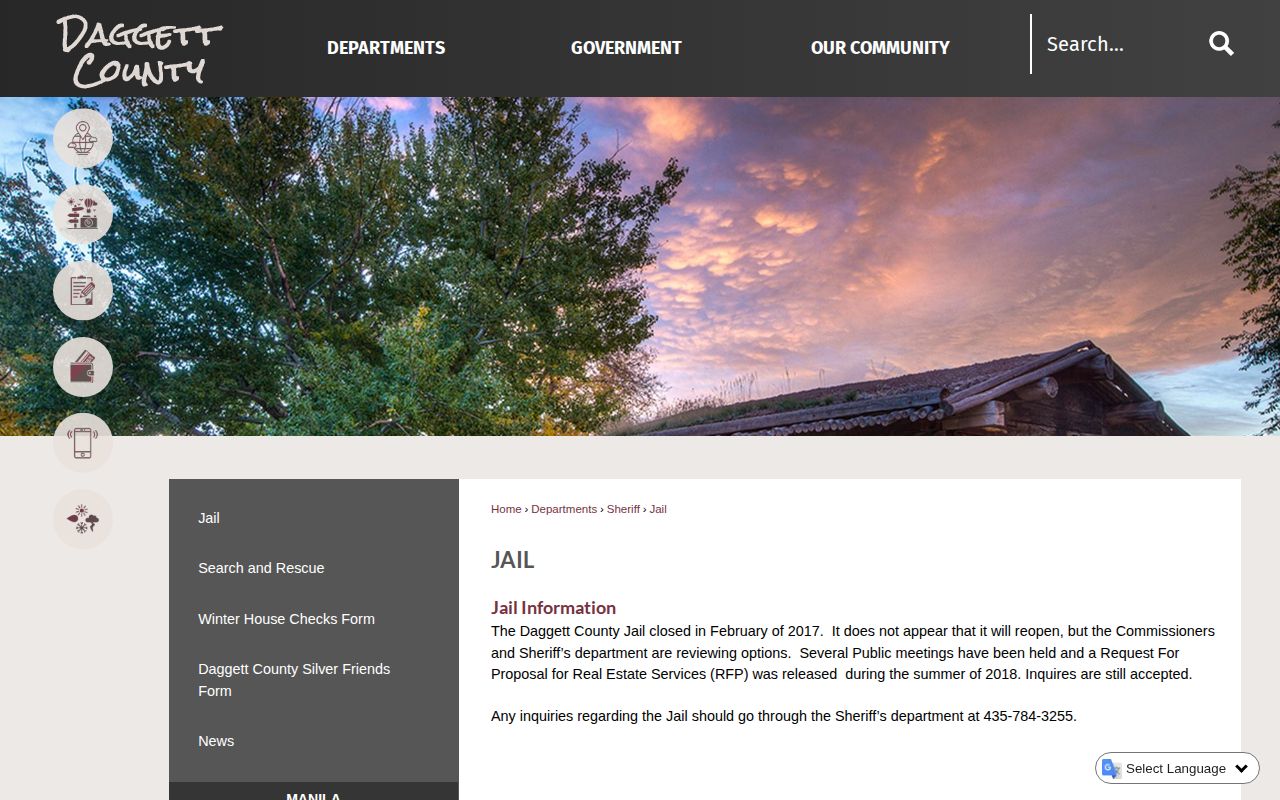
This official notice is more reliable than old commercial listings that still describe the former jail as active.
Historical record retention is a different question. The county GRAMA form points requesters to Utah Archives schedules. Ask the records officer which series governed the old booking or release log and whether the requested date survives. Never infer a retention term from online visibility, and never treat a missing result as proof that no custody event occurred.
Verify a Daggett County Release
A three-day timeline is strongest when each source performs its proper role. The holding agency establishes the physical exit. The court or Utah Board establishes the authority. VINE supplies an alert or status lead. UDC shows current state incarceration or supervision, but its public tool is not a complete historical archive after discharge.
| Source | What it can establish | Main limit |
|---|---|---|
| Receiving jail exit log | Actual facility exit, type, time, and possible destination | Only that custodian's episode |
| Court or Board record | Legal order, decision, case outcome, or parole authority | May not show physical departure time |
| VINE | Automated custody-change lead or alert | Participation, timing, and technical limits |
| UDC search | Current state incarceration, probation, or parole | Excludes unsentenced jail detainees and may omit discharged people |
Utah Courts Xchange can add the case history behind a release during the range. Search both District Court and Justice Court when the jurisdiction is uncertain, then compare the case number, party, filing date, and chronological entries with the jail record. Daggett's Justice Court handles lower-level matters within its authority, while felony and higher-level criminal cases belong in District Court. Xchange coverage for Daggett and Manila is complete only for cases filed after April 7, 2000, so an older incomplete result should lead to the clerk rather than to a claim that no case existed. A bond or release order shows legal authority. Only the holding agency can establish when staff carried it out.
For one named person beyond the three-day window, use the Daggett County release search paths. A historic court order or agency response may remain useful long after a live tool stops returning the person's name.